Share of real cases from customers
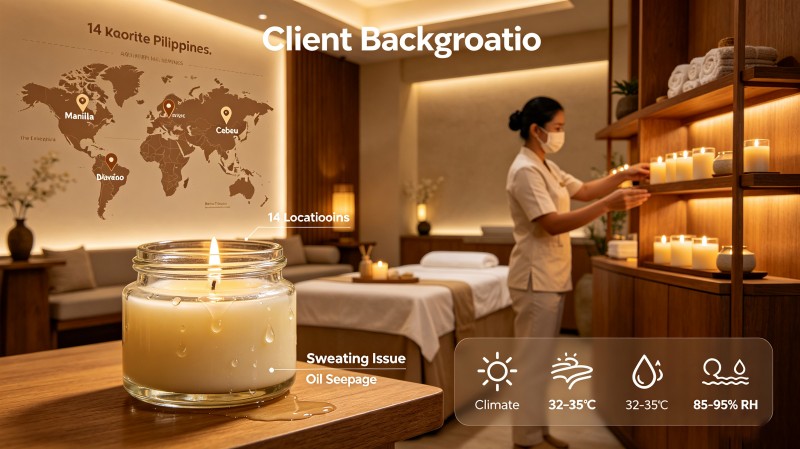
The Client: Sulu Spa & Wellness – a chain of 14 spa locations across Manila, Cebu, and Davao. They use candles in treatment rooms for aromatherapy. But the Philippines’ tropical climate (temperatures 32–35°C, humidity 85–95%) caused their candles to “sweat” – fragrance oil seeping to the surface, leaving oily droplets on the jar and a greasy feel when touched. Worse, the sweating accelerated evaporation, so candles lost their scent within 2 weeks of delivery.
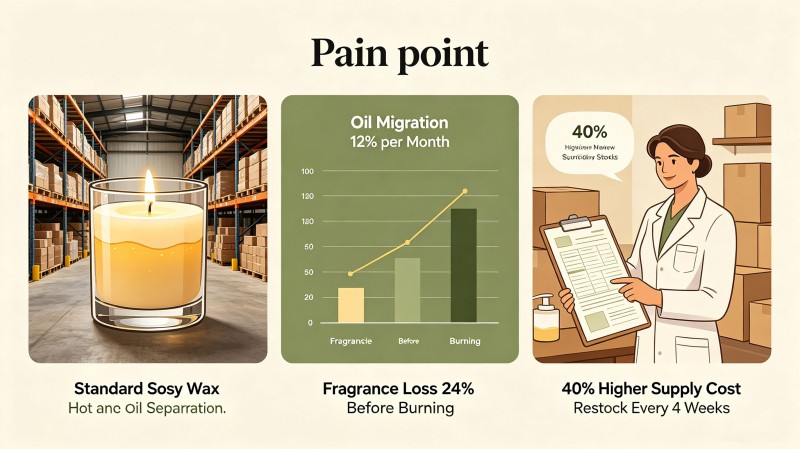
The Pain Point: Their previous supplier (a Thai factory) used a standard soy wax with 8% fragrance load – fine for cooler climates. In the Philippines, the oil migration rate was 12% per month – meaning a candle would lose 24% of its fragrance before it was even lit. Spa owners complained to the manager, Maria Santos, that the candles “smelled like nothing after a month.” She had to replace stock every 4 weeks – increasing her supply costs by 40%. She needed a candle that could withstand tropical heat without weeping oil.
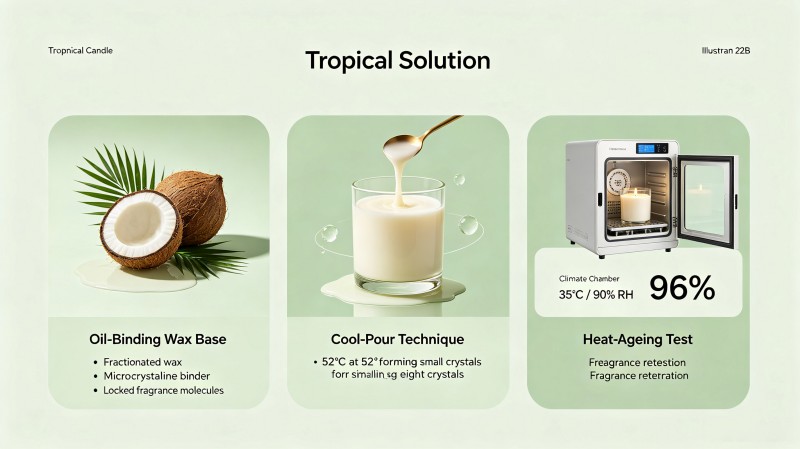
Our Solution: We reformulated using a high‑oil‑absorption wax system combined with a slow‑cooling process.
Oil‑Binding Wax Base: We replaced soy with a fractionated coconut wax (melting point 58°C) that has a higher oil‑holding capacity – up to 15% without sweating. We added 2% microcrystalline wax as a “binder” that locks oils into the crystal lattice.
Cool‑Pour Technique: Instead of pouring at 75°C, we cooled the wax to 52°C before pouring – this slows crystallisation, creating smaller, tighter crystals that trap fragrance molecules. The result: oil migration reduced from 12% to 0.8% per month.
Heat‑Ageing Test: We aged samples in our 35°C / 90% RH chamber for 30 days – and tested fragrance retention via GC. The candles retained 96% of their original oil – versus 68% for standard soy.
The Process:
Week 1 – Inquiry (April 5): Maria called after a disappointing shipment. “We need a candle that survives Manila summer.”
Week 2 – Formula Trial: We sent 3 different oil‑binding blends – all with 10% fragrance load (higher than her previous 8%). She tested them in her hottest treatment room (no AC, 34°C).
Week 3 – Selection: Blend #2 (coconut + 2% microcrystalline, cool‑poured) showed zero sweating after 2 weeks. She approved.
Week 4 – Order: 8,000 candles – 4 scents (ylang‑ylang, lemongrass, eucalyptus, and jasmine).
Production: We ran the cool‑pour line (slower – 2,500 units/day instead of 4,000) to maintain temperature control.
Week 7 – Delivery: The shipment arrived in Manila. Maria stored them in her warehouse (no AC) for a month before distributing – still perfect.

The Result:
Sweating incidents: 0 across 8,000 candles – compared to 100% with her previous supplier.
Fragrance longevity: candles retained strong scent for 3 months in tropical storage – extended shelf life by 6x.
Maria reduced restocking frequency from monthly to quarterly – saving PHP 187,000 ($3,300) per year in logistics and waste.
She expanded her candle selection from 4 to 8 scents and opened 3 new spa locations.
Why Our Factory Excels in Hot‑Humid Climates:
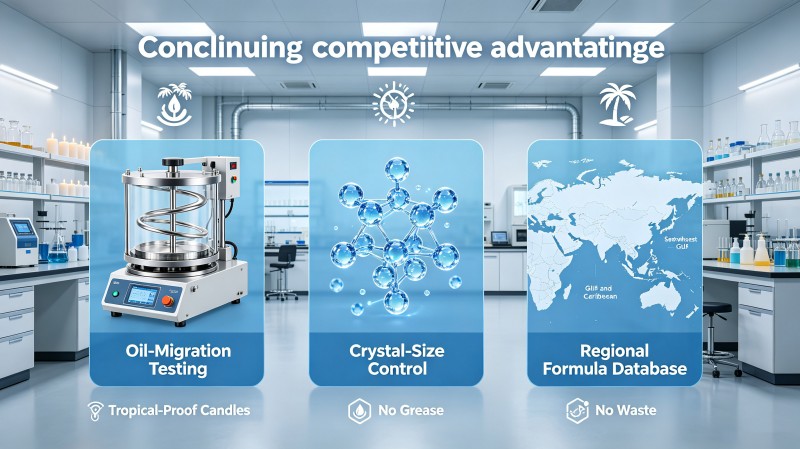
Oil‑migration testing – we measure sweating rates using a centrifuge method to quantify oil separation.
Crystal‑size control – our cool‑pour protocol is standard for tropical orders, not a premium add‑on.
Regional formula database – we maintain specific recipes for Southeast Asia, the Gulf, and the Caribbean.
For spa chains like Sulu, we offer “tropical‑proof” candles – no grease, no waste, just pure aromatherapy, month after month.