
Share of real cases from customers
The Client: Emma’s Home & Co., a boutique retailer based in Portland, Oregon, specializing in home fragrances and décor. Emma had been running the business for 4 years, sourcing candles from local artisans and importing from China. But every holiday season, she faced the same nightmare: overstocked pumpkin spice candles in January and understocked winter pine scents in December. Her inventory write-offs averaged $12,000 per year – a crushing sum for a small business.
The Pain Point: Emma needed variety – at least 15 different scents for each season – but her previous suppliers forced her to buy 2,000 units per SKU. Her storage unit was overflowing, and 40% of her capital was tied up in slow-moving inventory. Worse, lead times of 60–75 days meant she had to predict demand three months ahead. “I’m not a fortune teller,” she told us during our first Zoom call. “I need a partner who can produce small batches quickly, without making me pay boutique prices.”

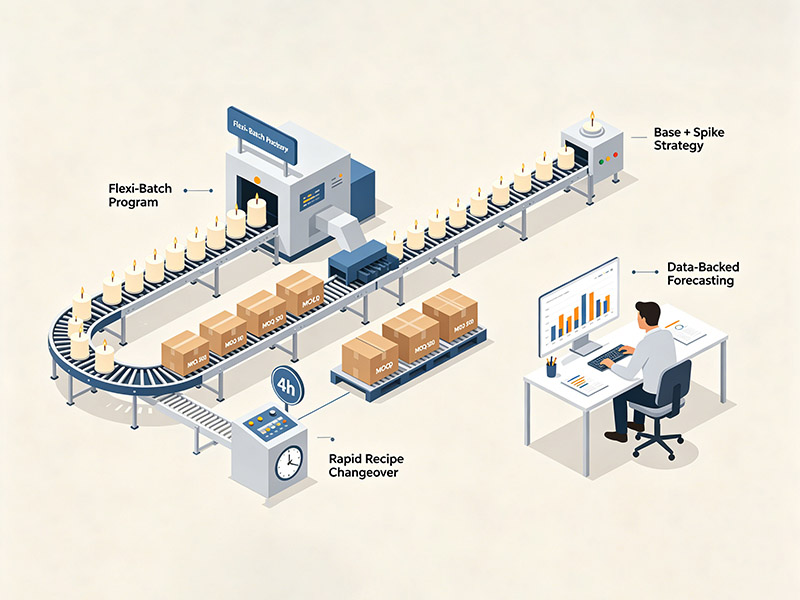
Our Solution: We introduced Emma to our Flexi-Batch Program – a hybrid model combining mass production efficiency with small-batch agility. Here’s what we did:
Low MOQ (Minimum Order Quantity) at 500 units per scent – instead of 2,000. This allowed Emma to test 6 new scents with just 3,000 total units, versus 12,000 elsewhere.
15-day lead time for reorders – achieved by keeping pre-made wax blends and wick assemblies for her top 10 core fragrances. For seasonal scents, we used a “rapid recipe changeover” process that takes only 4 hours on our production line.
Data-backed forecasting – our team analyzed her sell-through rates over 8 months and recommended a “base + spike” strategy: keep 40% of volume as evergreen scents (vanilla, lavender, sandalwood) and 60% as rotating seasonal offerings.

The Process: Emma sent us her initial request on March 12 – a mix of 8 spring scents (lilac, jasmine, fresh linen) totaling 4,200 units. We produced 3 rounds of wax-pour samples within 7 business days. On round 2, she wanted a deeper lilac color and a 10% softer fragrance throw. Our lab adjusted the fragrance oil concentration (from 8% to 7.2%) and added a natural soy-based dye. By March 28, she approved all samples.
The production run took 12 days. We shipped via sea-air hybrid (sea to Los Angeles port, then air to Portland) – a cost compromise that delivered in 18 days at 40% less than pure air freight. Emma received her candles on April 18, just in time for Mother’s Day promotions.
The Result: Emma sold 92% of the batch within 6 weeks – her highest sell-through rate ever. Inventory holding costs dropped from $4,200 per quarter to $2,950 (a 30% reduction). Most importantly, she placed a reorder for fall scents on July 1, increasing volume by 35% because she trusted our speed. “You guys turned my inventory from a liability into an asset,” she wrote in her testimonial.
Why Our Factory Stands Out: Emma’s story highlights three core strengths of our manufacturing operation:
Agile Production Lines: We run 6 independent casting lines that can switch recipes in under 2 hours. This allows us to handle orders as small as 500 units without slowing down our main 5,000-unit lines.
Proactive Client Analytics: We don’t just pour wax; we share sell-in, sell-through, and reorder prediction models. In Emma’s case, our data saved her from ordering 1,800 units of a peony scent that historically underperformed in her zip code.
Global Logistics Network: With consolidation hubs in Shanghai, we combine sea, air, and rail to match each client’s cost-speed preference. Emma saved $3.20 per unit compared to her previous supplier.
The takeaway? Whether you’re a small retailer or a big-box chain, our factory delivers small-batch flexibility, large-scale quality, and data-driven confidence. Emma now plans to expand from 1 store to 3, and we’re right there with her.