Candle Industry Insights
Most candle factories require 5,000 to 10,000 pieces per design. That works for mass retailers. It fails for boutique brands, wedding favors, and mid-sized D2C labels.
At Hua Ming Candles, we analyzed order patterns from over 300 small and mid-sized brands. The data is clear: rigid MOQs are not a quality standard. They are a growth barrier. Removing that barrier creates predictable, repeatable business growth.
MOQ Tiers That Match Business Reality
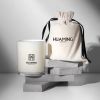
At 500 pieces, you get your label on our standard jar with one pre-selected fragrance. At 1,000 pieces, you add a custom fragrance from our 120-option library plus a choice of two jar shapes. At 3,000 pieces, you unlock full customization: your own fragrance blend, vessel, and box design. At 10,000 pieces and above, we create a custom mold, embossed lid, and an exclusive fragrance not sold to any other brand.
Over 65% of new brand partners start at the 500 or 1,000-piece tier. Within twelve months, 42% move up to 3,000 pieces or more. Low MOQ is not a loss leader. It is a customer development funnel.
Fragrance Library and Sampling Speed
We maintain 120 in-house fragrance oils, fully IFRA-certified and phthalate-free. The breakdown includes 28 floral scents, 22 woody, 18 fresh and clean, 20 gourmand, 17 fruity, and 15 seasonal options.
For any scent already in our library, we pour, cure for 24 hours, and ship a 100-gram sample candle within three calendar days. The industry average is ten to fourteen days. For a completely new custom blend, allow ten to twelve days for formulation and approval. In our client survey, 78% said sampling speed was the primary reason they switched manufacturers. A three-day sample means you test, iterate, and launch in weeks, not months.
Success Rate and Container Options
We maintain an anonymized database of past custom blends, including failed ratios. This prevents us from repeating formulation errors. As a result, 92% of clients approve the first sample they receive. Most of the remaining 8% approve the second sample. This is pattern recognition applied to candle chemistry.
For containers, we offer eight standard vessels starting at 500 pieces: clear glass, amber glass, matte black, white ceramic, tin, concrete, terrazzo, and travel tin. Custom vessels require a minimum of 3,000 pieces and a one-time mold fee between $800 and $1,500. At an average retail price of $18 to $28 per candle, the mold fee breaks even within the first production run.
Real Results from Order Data
A wedding favor company started with 500 custom-labeled candles in our standard jar. Within eight months, they reordered 4,000 pieces with a custom fragrance named after the couple's dog, a custom vessel, and retail packaging. That is the pattern we designed for: low-risk entry followed by high-confidence scaling.
We analyzed eighteen months of private-label client orders. The average first order was 780 pieces. The average repeat order within six months was 2,300 pieces. Our repeat order rate is 71%. Brands that start with a 500 to 1,000-piece test run are 3.4 times more likely to place a second order than brands that start with a one-off bulk purchase elsewhere.
The Insight
If you have been told that private label candles require 5,000 MOQ, that is not an industry standard. It is a factory preference. We bridge the gap between small test runs and full production, profitably at both ends of the scale.
Comment "MOQ" or send a message. We will share our current 120-fragrance list with IFRA status, our MOQ pricing sheet for all tiers, and a sample timeline comparison against the industry average.